Licensing criteria, environmental certification and assignment delivery for South Sinai and the Red Sea.
Day & evening visitsNo overnight accommodation
DESK STUDY · 26 NOVEMBER 2026
Regional & global baseline conclusions
Five purposively selected references: two regional examples and three global approaches. This is a qualitative design baseline for the assignment, not a measured environmental baseline for Hurghada, a systematic literature review or proof of regulatory equivalence.
Adopt an off-grid-capable daily visitor framework: secure essential safeguards through licensing, then reward verified environmental performance through a separate voluntary scheme.
Study scope and method
Primary public sources were reviewed for relevance to arid operations, environmental assessment, community benefits and certification design. Findings below distinguish government guidance, foreign permitting requirements, operator-reported practices and voluntary standards. The comparisons are qualitative: no common audited dataset establishes which destination performs best.
The Hurghada starting assumption—limited network water and electricity at target sites—comes from the assignment brief and still needs site verification. These sources do not establish that Hurghada has the region’s greatest infrastructure deficit. The existing October 2019 comparison remains a separate Egyptian reference exercise.
REGIONAL · Government sustainability guidance
Abu Dhabi, UAE
Source finding: DCT publishes sector-specific guidance and supporting policy and self-assessment tools. Its tour-operator guidance addresses energy, water, waste, procurement, culture, people and risk.
Proposed transfer to Hurghada: Use a simple policy, implementation plan and evidence register matched to each operator’s activities.
Transfer limitation: This is guidance, not evidence of a daily-camp licensing category or an Egyptian legal requirement.
Source finding: The operator describes solar-generated electricity prioritised for essential functions, solar hot water and community-operated transfers with revenue paid to participating drivers.
Proposed transfer to Hurghada: Assess critical power loads, solar feasibility and transparent local-benefit arrangements before selecting equipment or service levels.
Transfer limitation: An overnight lodge is not a direct daily-camp comparator. Its claims are operator-reported, not an independent performance audit; do not copy bedroom or shower provision.
Source finding: DOC requires an environmental impact assessment with applications for activities on public conservation land. Assessment detail varies with scale and potential effects; it informs conditions and monitoring.
Proposed transfer to Hurghada: Assess each camp footprint and associated routes proportionately; examine alternatives, impacts, mitigation and monitoring.
Transfer limitation: New Zealand law does not apply in Egypt. Use the assessment logic only; Egyptian authorities determine approvals, powers and conditions.
Source finding: ECO Certification covers nature-focused tours, accommodation and attractions. It is product-specific and checks operating permissions; the programme describes independent audits.
Proposed transfer to Hurghada: Define exactly which camp, excursion, vehicles and contractors are assessed. Require verified legal eligibility before making an environmental award.
Transfer limitation: Do not import its award names, fees or audit intervals automatically. An Egyptian scheme needs its own ownership, assurance and appeals arrangements.
Source finding: Version 4.01, dated 30 December 2025, organises sustainability around management, community benefits, cultural heritage and environmental impacts. It distinguishes sustainability risks from specialist health, safety and security responsibilities.
Proposed transfer to Hurghada: Cross-check coverage across the environmental scheme and community provisions; retain a separate licensing safety schedule.
Transfer limitation: Referencing GSTC does not confer certification, recognition or accreditation. It is a tour-operator benchmark, not a camp engineering code.
These are study recommendations inferred from the references, not requirements imposed by those sources on Egypt.
Conclusion
Benchmark basis
Proposed application
Hurghada evidence needed
Safe off-grid services
Feynan + Abu Dhabi
Accept technically verified off-grid systems; require safe water, sanitation and critical power regardless of connection status.
Supply reliability, water quality, tank condition, electricity loads and backup arrangements.
Water and wastewater
Abu Dhabi + local risk review
Use traceable deliveries, storage reconciliation and contained wastewater. Do not prescribe treatment technology without a site assessment.
Water source and volumes; wastewater volumes, removal records and authorised destination.
Energy transition
Feynan + Abu Dhabi
Reduce unnecessary loads, measure fuel and electricity, then assess renewable investment. Set a feasible baseline obligation and transition plan.
Load profile, solar yield assessment, maintenance capability and lifecycle cost.
Ecological footprint and routes
New Zealand DOC
Link capacity and operations to site sensitivity, route permissions and impact monitoring.
Flood and habitat assessment, route map, vehicle arrivals and disturbance records.
Community benefits
Feynan + GSTC
Use agreed consent, fair terms and transparent benefit records; avoid reducing culture to a staged compliance item.
Consultation, consent, payments, employment and complaint evidence.
Credible certification
Australia ECO + GSTC
Keep licensing eligibility separate from voluntary performance recognition; define scope and independent assurance.
Legal register, audit evidence, corrective actions, appeals and rules for public claims.
What the study supports
Use a common minimum safeguard schedule with site-specific conditions, then an improvement pathway based on verified evidence. A lack of grid connections should trigger assessment of safe alternative provision rather than automatic rejection or automatic exemption. Keep the daily visitor scope explicit and exclude sleeping-related specifications.
What the study cannot determine
The references do not establish Egyptian visitor limits, toilet ratios, water reserves, renewable-energy percentages, setback distances, certification scores or fees. Nor do they demonstrate a quantified business case for solar or wastewater treatment at a Hurghada camp. Those decisions require technical assessment, local cost data and authority agreement.
Recommended next steps
Confirm licensing scope and the competent authorities’ adoption route.
Survey a pilot sample covering different camp sizes, activities and supply arrangements; explain sample selection and its limitations.
Measure absolute resource use and intensity alongside visitors, meals, staff and operating days across representative conditions.
Test inspection questions and improvement costs with operators and communities.
Agree technical thresholds and certification governance after pilot review, then prepare the ministry submission.
Study status
Desk review completed for these five references; field validation, stakeholder consultation and legal verification remain open. Sources were accessed on 26 November 2026. No endorsement, certification or recognition by the referenced organisations is claimed.
DELIVERY WORKSPACE
Manage the overall assignment
Two connected outputs: a mandatory daily-visitor licensing proposal and a separate voluntary environmental certification proposal. Neither is adopted. Owners and deadlines below are planning fields, not confirmed commitments.
Local planning board: edits are saved only in this browser, not shared across devices or reviewers. Export a backup to retain or share your updates.
Delivery sequence
Confirm mandate and legal route → collect site baselines → review criteria and scheme → consult operators and communities → pilot inspections → revise technical thresholds → prepare ministry submission.
PROPOSED LICENSING SCHEDULE
New daily visitor criteria
Working summaries of the draft’s 36 criterion headings. They are not the full legal wording. All applicable baseline conditions must pass; hospitality grades and the voluntary environmental scheme remain separate. Day and evening visits only, with no guest accommodation.
Each criterion needs a final test, evidence requirement, applicability rule and responsible inspector before adoption. Consult the draft document under Sources & method for the full reference.
NEW WORKING PROPOSAL · FOR CONSULTATION
Desert Safari Environmental Certification
A voluntary performance scheme proposed alongside licensing, initially piloted with Hurghada desert operators. This is a new working scheme for this workspace, not a recovered or approved certification standard.
Assess outcomes in off-grid conditions
Connection to piped water or the electricity grid is not an eligibility requirement. Operators should demonstrate safe, traceable water provision, contained wastewater, reliable low-impact power and evidence of resource efficiency. Lack of infrastructure is not an exemption from health or environmental safeguards.
Entry gates
Verify applicable operating permissions; close critical environmental and safety nonconformities; establish a documented operating boundary, approved routes and a reliable baseline. No award should be issued while a critical breach remains open.
Proposed assessment process
Application and scope → documentary review → site audit → corrective action → independent decision → periodic surveillance and renewal. Provide an appeal route, conflict-of-interest controls, substantiation of public claims and suspension/withdrawal procedures.
Recognition and scoring: decision pending
Use a pilot checklist before selecting award tiers. Do not issue Bronze/Silver/Gold labels or claim certification yet. Weightings, minimum scores, mandatory indicators, verification period, audit fees, scheme owner and accreditation approach need stakeholder agreement. Improvement should be measured against each operator’s verified baseline without rewarding a poor starting position.
Scope boundaries
Record whether assessment covers the camp, vehicles, excursions and subcontractors. A camp-only award must not imply that every safari route or transport provider is certified. Water and energy performance must be reported alongside absolute consumption and visitor volume.
HURGHADA PILOT · EVIDENCE TO COLLECT
Start with the infrastructure reality
Planning assumption supplied for this assignment: many target desert safari sites operate without network water or electricity. This has not been established as a comparative ranking of Hurghada against other destinations. Confirm conditions site by site; no field measurements have been entered.
Proposed baseline protocol
Inventory every participating site and record its location, permissions, activities and operating days. Collect a representative operating period covering busy and quiet days, with seasonal follow-up. Record visitor numbers, staff, meals, animal use and service mix so comparisons remain meaningful. Validate delivery notes, meter readings and waste receipts against site observations.
Performance calculations
Water intensity = total operational water litres ÷ visitor-days. Electricity intensity = consumed kWh ÷ visitor-days. Report generator fuel separately in litres; do not treat fuel litres as kWh without a documented method. Renewable electricity share = renewable kWh consumed ÷ total electricity kWh consumed × 100. Also report total consumption, wastewater removed and waste generated; low intensity alone does not prove low impact.
No numerical benchmark, destination-wide baseline or claim of certification is asserted. Set targets only after validating the pilot data and service categories.
REFERENCE TO PROPOSAL
Explore the mapping
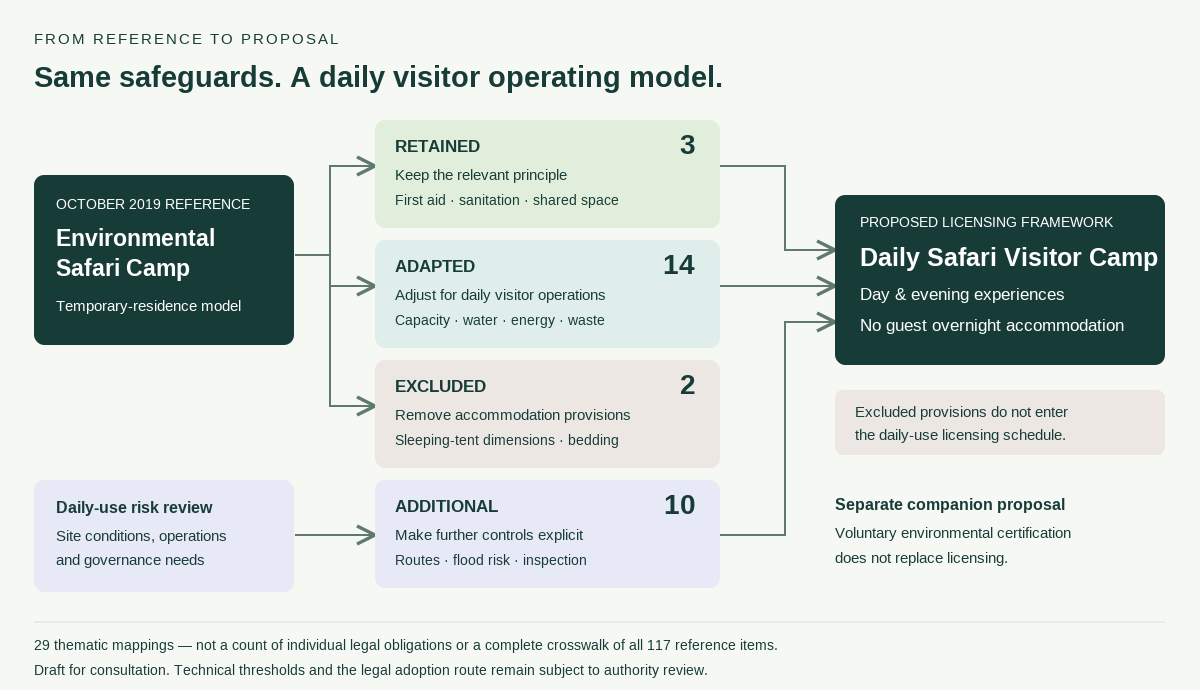
29 thematic mappings. Select a treatment, narrow by topic, or search a criterion. Expand any row for the proposed change and its review question.
Mapping logic at a glance. Counts describe the 29 thematic groups in this workspace. Select a category below to inspect its provisions.Download illustration (SVG)
2019 item → draft criterion
Provision2019 itemDraft referenceTreatment
“Retained” means the principle is retained, not that every number or specification is unchanged. “Additional” means made explicit in the proposal; it does not mean absent from Egyptian law. This is a selective thematic crosswalk, not an exhaustive mapping of all 117 reference items.
TECHNICAL & REGULATORY REVIEW
Decisions still to be resolved
These are proposed review questions, not agreed ministry positions. Suggested reviewing bodies are indicative; all nine decisions remain open.
COMPARATIVE CONCLUSION
A dedicated daily-use category is the proposal.
The October 2019 reference addresses a temporary-residence safari camp and contains accommodation specifications and hospitality classification criteria. The proposed framework addresses a venue for day and evening experiences, with no guest sleeping.
The appropriate policy direction is to preserve relevant environmental, sanitation, service and safety principles while reassessing their application to daily visitor operations. Removing beds and sleeping-tent specifications does not remove the need for safe shelters, suitable occupancy, sanitation or emergency arrangements.
The proposal should operate as a dedicated daily-visitor licensing schedule, subject to confirmation of the legal category and adoption mechanism by the competent authorities.
The draft uses applicable baseline requirements rather than a hospitality points system. It makes capacity, routes, flash-flood exposure, waste traceability, cultural consent and inspection evidence explicit. Each site still needs the applicable land, environmental, activity and protected-area permissions.
What must be settled before adoption
The authorities must confirm the legal route, technical thresholds and site-specific annexes. Particular care is needed to preserve the 2019 energy principle, confirm language and guide qualifications, reconcile waste requirements and turn composite criteria into measurable inspection questions.
Egyptian Hotel Association-hosted hospitality classification document, bearing MoT–EHA–UNWTO attribution. Mapping references use its item numbers. Its current legal force and applicability require ministry confirmation.
Draft prepared for the South Sinai and Red Sea daily visitor model. G: governance; E: environment; S: safety; C: community and culture. Section 11 covers destination conditions; section 12 covers inspection. This proposal is not an adopted regulation.
Consult the competent authorities for the applicable approval path, permit conditions and current technical requirements. These links support follow-up verification; they are not treated as approval of the proposed framework.
The four treatments describe policy intent at a thematic level. Conditional shower provision is grouped as adapted. Additional rows have no single claimed 2019 counterpart. Mapping counts are editorial groups, not a count of legally binding obligations. Numerical limits are deliberately left open where technical agreement is required. Regional and international benchmarking is presented separately in the Benchmark study tab.
Workspace prepared 25 November 2026. Source reference: October 2019. No live legal-status monitoring. The website provides a read-only review; it does not record official decisions.